
Blog
Mountain Bike Size Guide: How to Choose the Right Frame

How to Choose the Right Frame
Choosing the right mountain bike frame size is one of the most important decisions you can make before buying a new bike. A mountain bike that fits properly can improve comfort, control, pedaling efficiency, confidence, and overall enjoyment on the trail. On the other hand, riding a frame that is too large or too small can make the bike difficult to handle and may contribute to discomfort during longer rides.
Modern mountain bikes have also changed considerably. Frame geometry is no longer determined simply by a rider’s height and the length of the seat tube. Measurements such as reach, stack, wheelbase, standover height, and head-tube angle can have a significant effect on how a bike feels.
This guide explains how to choose the right mountain bike frame using your height, inseam, riding style, and the manufacturer’s geometry chart.
Why Mountain Bike Frame Size Matters
Frame size affects nearly every aspect of your riding position. A properly sized mountain bike allows you to maintain a balanced position over the wheels while keeping enough room to move your body when climbing, cornering, descending, or riding technical terrain.
A correctly sized frame can help you:
- Maintain better control on uneven trails
- Ride more comfortably for longer periods
- Pedal efficiently
- Move your body naturally around the bike
- Maintain better balance during descents
- Reduce unnecessary strain on your hands, back, shoulders, and legs
- Feel more confident when riding technical terrain
A frame that is too small may feel cramped, nervous, or unstable at higher speeds. A frame that is too large may feel difficult to maneuver and can make it harder to shift your weight quickly.
The goal is not simply to find a frame labeled “Medium” or “Large.” The goal is to find a frame whose actual geometry works with your body and riding style.
Start With Your Height
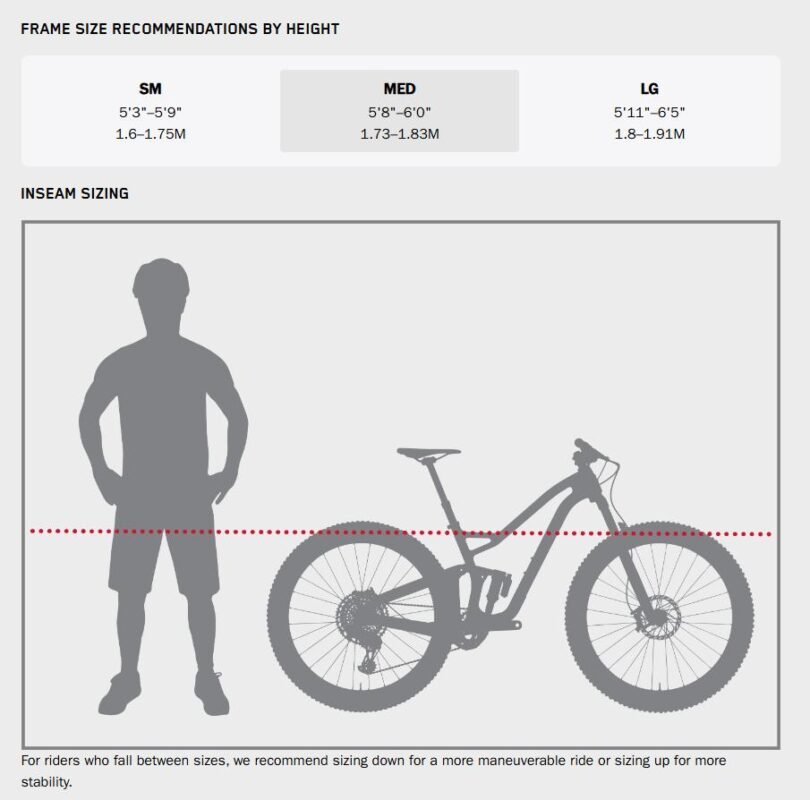
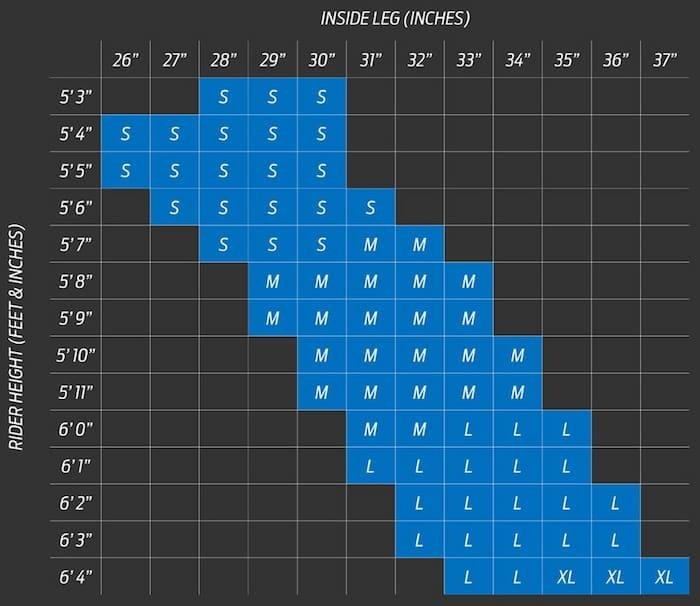
Your height is the easiest measurement to use when beginning the sizing process. Most mountain bike manufacturers provide recommended height ranges for each frame size.
As a general starting point, the following ranges can be useful:
| Rider Height | Typical MTB Frame Size |
|---|---|
| 4’10″–5’2″ (148–158 cm) | XS |
| 5’3″–5’6″ (159–168 cm) | S |
| 5’7″–5’10” (169–178 cm) | M |
| 5’11″–6’1″ (179–185 cm) | L |
| 6’2″–6’4″ (186–193 cm) | XL |
| 6’4″+ (194+ cm) | XXL |
These figures are only a starting point. Manufacturer sizing charts can differ substantially because frame geometry varies between brands and models. A manufacturer’s specific size chart should always take priority when you are choosing a particular bike.
Measure Your Inseam
Height alone does not tell the whole story. Two riders can have the same height but very different leg and torso proportions.
Your inseam measurement helps determine whether you have enough clearance over the frame and whether the saddle can be positioned correctly.
How to Measure Your Inseam
- Stand barefoot on a hard, level surface.
- Place your feet approximately shoulder-width apart.
- Put a book between your legs with its spine firmly against your body.
- Keep the book level, similar to the position of a bicycle saddle.
- Measure from the floor to the top of the book.
- Record the measurement in inches or centimeters.
Use your inseam together with your height when comparing frame sizes.
Inseam is particularly useful when you are close to the boundary between two sizes. It can also help identify potential standover issues before purchasing a bike.
Understanding Mountain Bike Size Labels
Mountain bikes are commonly sold using labels such as XS, S, M, L, XL, and XXL. Some bikes, particularly older models, may instead use frame measurements in inches.
However, these labels are not standardized across every manufacturer.
For example, a Medium from one brand may have a similar reach to a Large from another brand. This is why experienced riders often pay attention to the actual geometry numbers rather than relying only on the size label.
A manufacturer’s size chart should therefore be considered a starting point rather than an absolute rule.
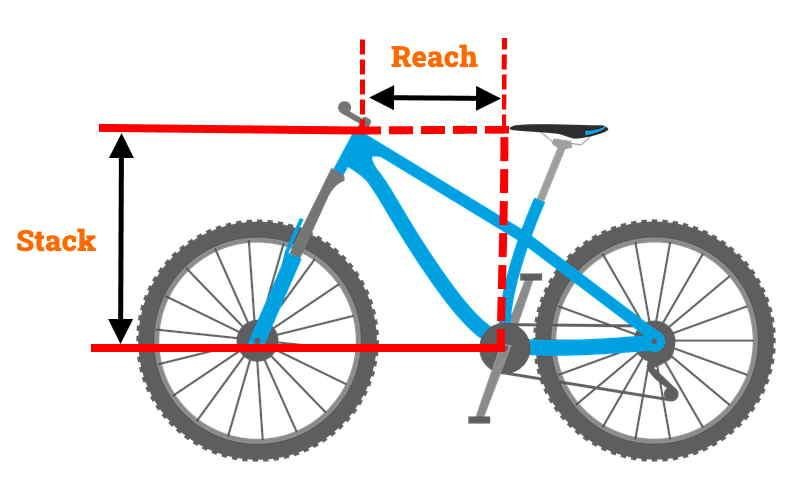
What Is Reach?
One of the most important measurements on a modern mountain bike is reach.
Reach describes the horizontal distance from the bottom bracket area toward the head tube and provides a useful indication of how long the bike will feel when you are standing on the pedals.
A longer reach generally creates a more stretched-out riding position and can provide additional stability, particularly when descending. A shorter reach can make a bike feel more compact and maneuverable.
Reach is particularly important on modern mountain bikes because riders frequently spend significant amounts of time standing on the pedals while descending technical trails.
When comparing two bikes, don’t assume that identical size labels mean identical fit. Compare the reach figures in the geometry charts.
What Is Stack?
Stack is another important geometry measurement.
It describes the vertical position of the front end of the bike relative to the bottom bracket. Stack influences how high or low your handlebars will be and therefore affects your riding position.
A higher stack can create a more upright position, which some riders may prefer for comfort and control. A lower stack can create a more aggressive position and may be preferred for certain performance-oriented riding styles.
Reach and stack should be considered together rather than individually.
A bike with a long reach and low stack can feel considerably different from one with the same reach but a higher stack.
Standover Height
Standover height refers to the clearance between the ground and the upper portion of the frame when you stand over the bike.
You want enough clearance to comfortably stand over the bike, especially when stopping on uneven terrain or moving your body during technical riding.
However, modern mountain bikes often have dropped top tubes and sloping frame designs, so traditional standover measurements should not be considered the only factor.
Your inseam, frame design, and the amount of movement you need while riding should all be considered.
Choosing Between Two Frame Sizes
Many riders find themselves between two recommended frame sizes.
For example, your height might place you at the upper end of a Medium and the lower end of a Large.
This is where riding style and geometry become especially important.
Consider the Smaller Frame If You Prefer:
- Quick handling
- A more compact riding position
- Easier maneuverability
- Tight and technical trails
- A playful feel
- Frequent body movement around the bike
A smaller frame can feel easier to maneuver, particularly on tight trails.
Consider the Larger Frame If You Prefer:
- High-speed stability
- Longer descents
- More stretched-out positioning
- Greater stability on rough terrain
- Aggressive trail or enduro riding
A larger frame can provide a more stable feeling, provided that its reach and standover dimensions remain comfortable.
There is no universal rule that says you should always size down or always size up. The correct choice depends on your proportions, the bike’s geometry, and the type of riding you do.
Think About Your Riding Style
Your riding style should influence your frame choice.
Cross-Country Riding
Cross-country riders often prioritize efficient climbing, pedaling performance, and quick handling.
If you primarily ride long distances and smoother trails, you may prefer a fit that provides efficient positioning without feeling excessively stretched.
Trail Riding
Trail bikes are designed to handle a broad variety of terrain. For many riders, this makes balanced geometry particularly important.
A comfortable reach, suitable stack, and adequate standover clearance can help you maintain control during both climbs and descents.
Enduro Riding
Enduro riders commonly spend significant time descending challenging terrain. Stability and control become increasingly important.
A longer and more stable frame may suit riders who prioritize confidence at speed, although the bike must still allow comfortable climbing and body movement.
Downhill Riding
Downhill bikes are designed specifically for descending steep and technical terrain. Their geometry is substantially different from that of many cross-country bikes.
For this type of riding, choosing the exact frame recommended by the manufacturer is especially important because suspension travel, wheelbase, reach, and other geometry measurements all work together.
Wheel Size Also Matters
Wheel size can influence how a mountain bike fits and feels.
Common wheel sizes include 27.5-inch and 29-inch wheels, while some bikes use mixed-wheel configurations.
Larger 29-inch wheels can roll efficiently over obstacles and provide a different riding feel from smaller wheels. They can also influence the overall proportions and fit of a bicycle.
This means you should not select a frame based solely on the wheel size.
A manufacturer may design a particular frame around a specific wheel size, so always check the geometry and sizing recommendations for the exact model you are considering.
Don’t Ignore the Saddle Position
After selecting the correct frame, your saddle position needs to be adjusted correctly.
The saddle should allow you to pedal efficiently without forcing your legs to overextend or your hips to rock from side to side.
A correctly adjusted saddle height can improve pedaling comfort and efficiency. It also helps ensure that your riding position works with the frame rather than against it.
However, saddle height should not be used to compensate for choosing the wrong frame size.
For example, raising the seatpost cannot fix a frame that has an unsuitable reach.
Handlebar Position and Cockpit Fit
The distance between your saddle, handlebars, and grips affects how the bike feels.
If the cockpit is too long, you may feel excessively stretched. Your shoulders, arms, or hands may become uncomfortable, especially during longer rides.
If it is too short, you may feel cramped and have difficulty maintaining a balanced position.
Stem length, handlebar width, handlebar rise, and spacers can make relatively small adjustments to fit, but they should be considered fine-tuning tools, not substitutes for selecting the correct frame.
The frame itself should be fundamentally appropriate for your body.
Signs Your Mountain Bike May Be Too Small
Your frame may be too small if you consistently notice:
- A cramped cockpit
- Excessive pressure on your hands
- Difficulty maintaining a balanced standing position
- A feeling that your knees or arms are unusually close together
- An unstable feeling at speed
- Limited room to move your body on descents
These symptoms can have other causes, including incorrect saddle position, handlebar setup, or suspension settings, so they should not automatically be interpreted as proof that the frame is too small.
Signs Your Mountain Bike May Be Too Large
A frame may be too large if you experience:
- Excessive stretching toward the handlebars
- Difficulty moving the bike through tight corners
- Trouble getting comfortable over the front or rear of the bike
- Difficulty standing over the frame
- A feeling that the bike is difficult to control at low speeds
- Difficulty maintaining a natural riding position
Again, component adjustments should be checked before deciding that the frame is incorrect.
Compare Geometry, Not Just Frame Size
When purchasing a mountain bike online, one of the best approaches is to compare the geometry chart for the exact model.
Pay attention to:
- Reach
- Stack
- Seat tube length
- Effective top tube
- Wheelbase
- Chainstay length
- Head angle
- Seat angle
- Standover height
Geometry charts may initially look complicated, but they provide much more information than a simple XS, S, M, L, or XL label.
Modern mountain bike geometry places particular importance on measurements such as reach and stack because these numbers provide useful information about the rider’s position and the bike’s handling characteristics.
A Practical Example
Imagine a rider who is 5’10” tall.
A general sizing chart might place this rider around a Medium frame. However, if the rider has unusually long legs, a long torso, or a preference for aggressive trail riding, the Medium may not automatically be the best choice.
The rider should compare:
- Height
- Inseam
- Manufacturer’s size recommendation
- Reach
- Stack
- Standover height
- Intended riding style
- Geometry of a bike the rider already likes
This process is much more reliable than simply ordering the first Medium-sized mountain bike available.
Use a Bike You Already Ride as a Reference
If you already own a mountain bike that fits you well, its geometry can be an excellent reference point.
Record the frame size, reach, stack, wheelbase, and other available geometry measurements.
Then compare those numbers with the bike you are considering.
This approach can be particularly useful when buying online because you can identify whether the new bike will have a longer, shorter, higher, or lower riding position than your current bike.
Test Ride Whenever Possible
A test ride remains one of the best ways to evaluate frame size.
When testing a mountain bike, don’t simply ride around a parking lot for a few seconds. If possible, evaluate how the bike feels:
- While seated
- While standing
- During climbing
- During braking
- Through corners
- On uneven terrain
- During slow-speed maneuvering
Pay attention to whether you feel centered on the bike and whether you can move your body naturally.
If you are purchasing an expensive mountain bike, a professional bike fit can also be worthwhile.
Common Mountain Bike Sizing Mistakes
Mistake 1: Choosing Only by Height
Height is an excellent starting point, but it is not enough by itself.
Your inseam and body proportions can change the ideal frame size.
Mistake 2: Assuming Every Medium Is the Same
Frame sizing is not standardized across every brand.
Always check the geometry chart for the exact model.
Mistake 3: Ignoring Reach
A frame can have a familiar size label while feeling dramatically different because of its reach.
Mistake 4: Using the Seatpost to Fix a Wrong Frame
Seatpost adjustment is useful for saddle height, but it cannot correct every problem created by an incorrectly sized frame.
Mistake 5: Choosing Based Only on Wheel Size
A 27.5-inch or 29-inch wheel does not automatically tell you which frame size is right.
Mistake 6: Forgetting Riding Style
The ideal frame for cross-country riding may not be the ideal frame for aggressive enduro riding.
Quick Mountain Bike Frame Sizing Checklist
Before purchasing your next mountain bike, confirm the following:
- Height: Measure your height accurately.
- Inseam: Measure your leg length.
- Manufacturer chart: Check the exact model’s sizing recommendations.
- Reach: Compare the bike’s reach with a bike that fits you well.
- Stack: Consider your preferred riding position.
- Standover: Make sure you have appropriate clearance.
- Wheel size: Check how the selected wheel configuration affects the bike’s geometry.
- Riding style: Consider whether you primarily ride XC, trail, enduro, or downhill.
- Test ride: Try the bike when possible.
- Professional fit: Consider a fitting if you are between sizes or experience persistent discomfort.
Frequently Asked Questions
Should I choose a smaller or larger mountain bike frame?
If you fall between sizes, either option may work. A smaller frame can feel more maneuverable, while a larger frame may provide additional stability. Compare reach, standover clearance, and riding style before deciding.
Is height enough to choose a mountain bike?
No. Height is the first measurement to consider, but inseam, reach, stack, frame geometry, and riding style are also important.
Does frame size affect mountain bike handling?
Yes. Frame dimensions influence your position relative to the wheels and affect how the bike responds to steering, braking, climbing, and descending.
Can I make a wrong-size bike fit with a longer stem?
Component changes can fine-tune a good frame fit, but they cannot completely correct an unsuitable frame. It is better to select the correct frame first and use components for small adjustments.
Is a 29er harder to fit?
Not necessarily. Many riders can comfortably ride 29-inch mountain bikes, but wheel size is one part of the overall bike design. Check the manufacturer’s size recommendations for the specific model.
Final Thoughts
Choosing the right mountain bike frame is about much more than selecting a letter on a size chart. Height provides the starting point, inseam confirms your proportions, and frame geometry determines how the bike actually fits and handles.
The most important measurements to understand are reach, stack, standover height, wheelbase, and the overall geometry of the bike. Your riding style should also influence the final decision.
If you are between sizes, compare the geometry of both options and think about how you want the bike to feel. Riders who prioritize agility may prefer the more compact option, while riders who prioritize stability may appreciate a longer frame—provided the reach and standover remain comfortable.
Most importantly, always consult the manufacturer’s sizing chart for the specific mountain bike model you are considering. General charts are useful starting points, but mountain bike geometry varies considerably between brands and models.
A correctly sized mountain bike should feel natural beneath you. You should have enough room to move, maintain a balanced position, pedal comfortably, and control the bike confidently on the terrain you ride most often.
The right frame is not simply the one that matches your height—it is the one that matches your body, riding style, and the way you want your mountain bike to perform.